How to use an action camera for scuba diving

Guide · Action camera

How to use an action camera for scuba diving

GoPro, Insta360, and DJI cameras can go in the water without a housing, but not to dive depths. With the right housing, an action camera is light, simple, and great for video. What makes the image is the usual: get close, take care of color, and hold still.

How deep it goes without a housing

Action cameras come water resistant out of the box. The figures below come from the official pages.

Before you get in, check doors and covers. DJI asks you to close the battery and USB-C covers and tighten the glass lens cover. Insta360 asks for clean seals, closed covers, and the lens guards removed.

  • GoPro HERO13 Black: 10 meters (33 feet) without a housing.
  • Insta360 X5: 15 meters (49 feet).
  • DJI Osmo Action 6: 20 meters (about 65 feet) without a case. Below about 14 meters, the camera disables the record button because of the pressure, leaving the side button.

On a dive, use the housing

All three brands sell their own housing, and all of them are rated to 60 meters (about 197 feet): the GoPro Protective Housing for HERO10 to HERO13 Black, the Invisible Dive Case for the X5, and the Waterproof Case for the Osmo Action 6.

DJI recommends the case for long underwater shoots. On the Insta360, the case also fixes the image: in 360 mode, water and air bend light differently, which disrupts the stitching between the two lenses.

With a housing, the usual ritual applies: assemble it calmly on a clean table, keep the seal free of even a single hair, and test it before the dive. Afterward, fresh water: Insta360 says to rinse and soak it for 5 to 10 minutes after the ocean.

Red filter in the shallows, video light deeper

An action camera works in auto and doesn't pair well with a strobe. The filter and the video light take its place.

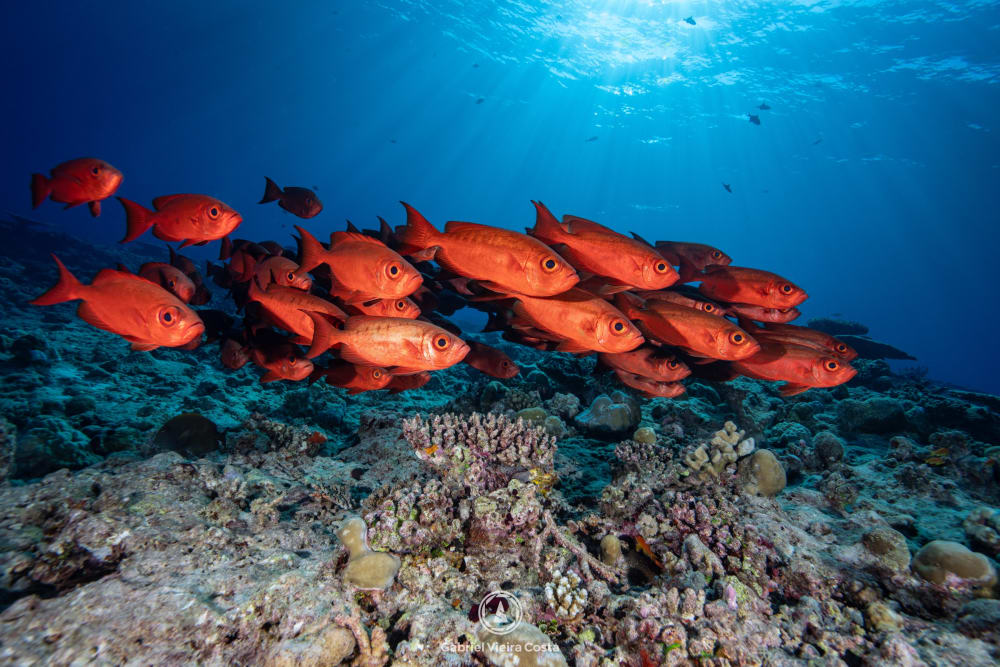
A red filter brings back some color in blue water. For green water, magenta. GoPro recommends both between 15 and 75 feet, and they work best in shallow water with sun: the deeper you go, the less color is left to recover.

A video light brings color back at depth and in shade, but only up close: it travels to the subject and back to the lens, so distance counts twice. It is for video, for focusing, and for small subjects nearby.

Filter for the shallows in sunlight. Video light for close-ups and depth.

Photo or video?

An action camera is great for video and for getting started. For stills, the limit shows up in low light and when you want a strobe, which is hard to use with it. Close-up color depends on the sun, the filter, or the video light.

If your camera allows it, lock a maximum ISO so the image doesn't get grainy, and set manual white balance on light sand at the depth where you will film. DJI says the Osmo Action 6 sensor corrects color temperature underwater on its own; even so, color that never reached the lens won't come back.

Get close, then closer

An action camera lens is very wide, and that is deceiving: on screen the subject looks close, but in the water it is far. Less water between the lens and the subject means more color, more sharpness, and fewer particles.

With a wide lens, keep the main subject within a meter, ideally a hand span or two away. Shoot from below: the subject stands out against open water and, against the sun, becomes a silhouette. For macro, you need a close-up lens.

Half the distance is worth more than any new camera.

Stability: float before you film

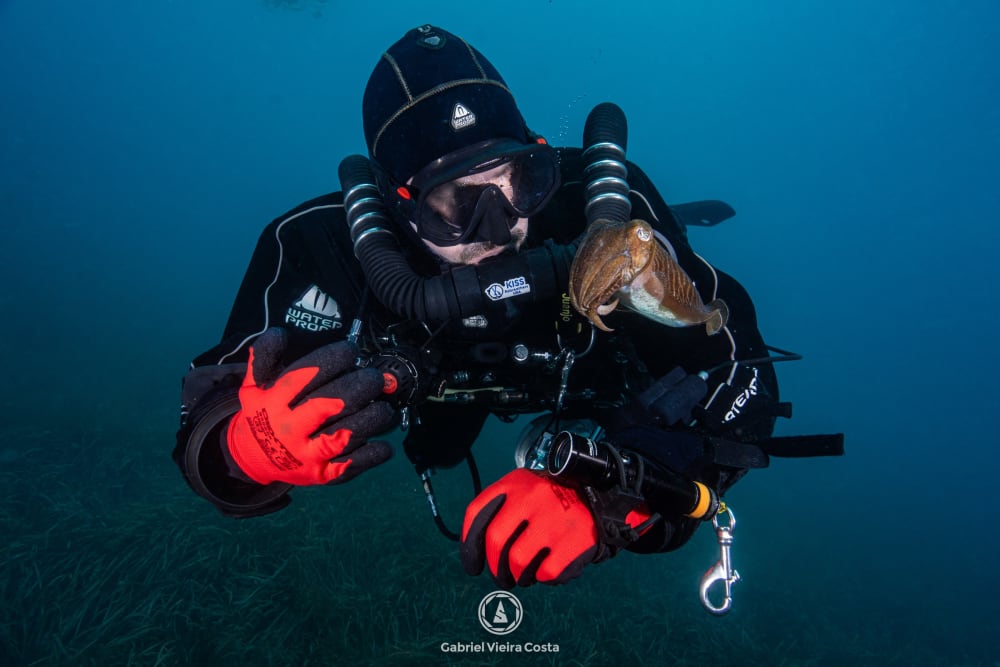
Holding still without moving your hands or fins comes before the camera. With an action camera it matters even more: it is light, and every body movement shows up in the image.

The rule is no contact with anything alive. If you need support, one finger on bare sand or rock, with the rest of your body floating.

And the camera steals your attention. Every time you change subjects, check your air, depth, and time. Scuba diving only with training and a certification.

Don't touch, don't chase, don't feed. The animal decides the distance.

By Gabriel Vieira Costa, underwater photographer, World Top 10 at 35AWARDS 2025 and 2026 and SDI/TDI Instructor Trainer.
Frequently asked questions

How deep can a GoPro go without a housing?

The HERO13 Black goes to 10 meters (33 feet), according to GoPro. With the Protective Housing, to 60 meters (196 feet). For scuba diving, use the housing.

Which dive housing fits the GoPro HERO13?

GoPro's own Protective Housing, made for the HERO10 to HERO13 Black and rated to 60 meters. GoPro warns that using it with other models can damage the camera or the housing.

Does a red filter work on a GoPro?

Yes, in blue water, in the shallows, with sun. In green water, use magenta. Deeper down, there is little color left for the filter to recover, and it has to come from a video light, up close.

Can the Insta360 X5 dive without a case?

It is rated to 15 meters, but Insta360 recommends the Invisible Dive Case for underwater shooting. The case goes to 60 meters and avoids stitching problems in 360 mode.

What about the DJI Osmo Action 6?

It goes to 20 meters without a case and to 60 meters with the Waterproof Case. Without the case, below about 14 meters the record button is disabled by the pressure.

From action camera to the image you saw

The Underwater Photography masterclass covers light, exposure, and gear, module by module, from a photographer who has dived in more than 60 countries.

And for your screen

My photos as free wallpapers, for desktop and phone.

More guides

How to take photos underwater

How to take photos underwater

Why underwater photos come out blue and flat, and five practical steps to fix them with a phone, action camera, compact, or mirrorless.

Read the guide
How to choose an underwater camera and housing

How to choose an underwater camera and housing

Goal, total system cost, housing, dome or flat port, and lighting: the order of questions to pick an underwater camera without wasting money.

Read the guide
How to take underwater photos with a phone

How to take underwater photos with a phone

Housing, depth, light, filters, and how to avoid a flood: what works and where a phone hits its limits when you take photos underwater.

Read the guide
Can you take underwater photos with an iPhone or any other phone?

Can you take underwater photos with an iPhone or any other phone?

IP68 doesn't mean dive-ready. What Apple, Samsung, and Google say about the ocean, pools, and warranty, and the safe way to take photos in the water.

Read the guide
Underwater strobes: how to use your flash

Underwater strobes: how to use your flash

What a strobe is for, where to put your arms and strobes, how to avoid backscatter, how much power to use, and when to switch the strobes off.

Read the guide
How to edit underwater photos

How to edit underwater photos

The order of adjustments for editing underwater photos in Lightroom: white balance, light, haze, color, and cleanup, and why water turns it all blue.

Read the guide
How to photograph caves and cenotes

How to photograph caves and cenotes

How to photograph caves and cenotes: exposure in the dark, continuous light from dive lights, team and model, composition, and safety first.

Read the guide
How to photograph sharks and big animals

How to photograph sharks and big animals

Sharks, manta rays, and whale sharks: wide-angle lens, distance, natural light or strobes, shutter speed, and respect for the animal.

Read the guide
Where to take underwater photos in Brazil

Where to take underwater photos in Brazil

Laje de Santos, Angra, Ilha Grande, Ilhabela, Noronha, Recife, and Natal: what to photograph underwater at each, the best season, and what to pack.

Read the guide