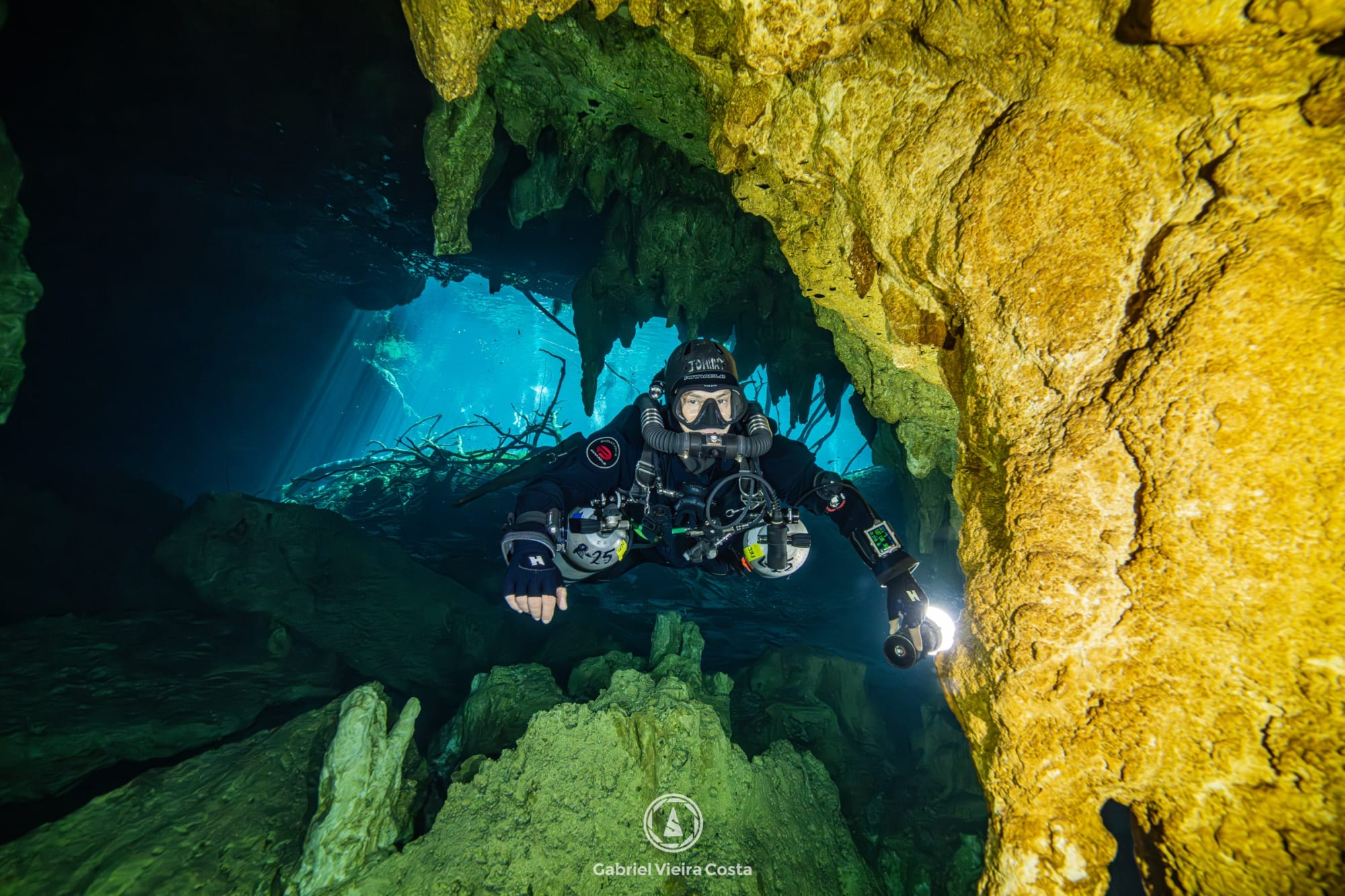
Is cave diving dangerous?

Guide · Cave diving

Is cave diving dangerous?

Yes, and for anyone who goes in without training it can be fatal. With a course, the right equipment, and limits, the risk is managed, but it does not go away. The ceiling changes everything: in a cave, you can't go straight up.

The ceiling changes everything

In open water, almost every problem has the same way out: a controlled ascent. In a cave there is rock between you and the surface, and the way out is to swim back to the entrance. That is why ocean experience is not enough.

This guide does not teach cave diving, and no text replaces the course.

  • Darkness: past the daylight zone, the only light is the light the team brought.
  • Silt: one kick near the floor can wipe out visibility in seconds.
  • Navigation: passages split like a maze.
  • Gas: it has to cover the way in, the way out, and the unexpected.

The classic causes of accidents

In 1979, the American diver Sheck Exley published a manual that used accident analysis to show what works. The NSS-CDS, the cave diving section of the National Speleological Society, gives the book away for free.

Training agencies agreed that most deaths came from breaking one of three rules: line, gas, and depth. Five years later, training and lights were added. The five are the basis of cave courses.

  • Training: going in without a cave course.
  • Guideline: not having a continuous line to the surface.
  • Gas: using more than a third on the way in. This is the rule of thirds: one to go in, one to get out, one in reserve.
  • Depth: going deeper than is safe for the gas being breathed.
  • Lights: carrying fewer than three, each able to last the whole dive.

What the numbers show

A study using data from DAN, the diving safety network, gathered 161 deaths in US caves between 1985 and 2015. Deaths fell from eight a year to fewer than three.

But 67 of those people had cave training. Among them, the rule broken most often was the rule of thirds. The most common path: silt rises, the diver gets lost, and the gas runs out. In 27 of the 67 cases, at least one rule was broken. Following the rules is the minimum, and it does not bring the risk to zero.

Cavern vs cave: the daylight zone and the stop sign

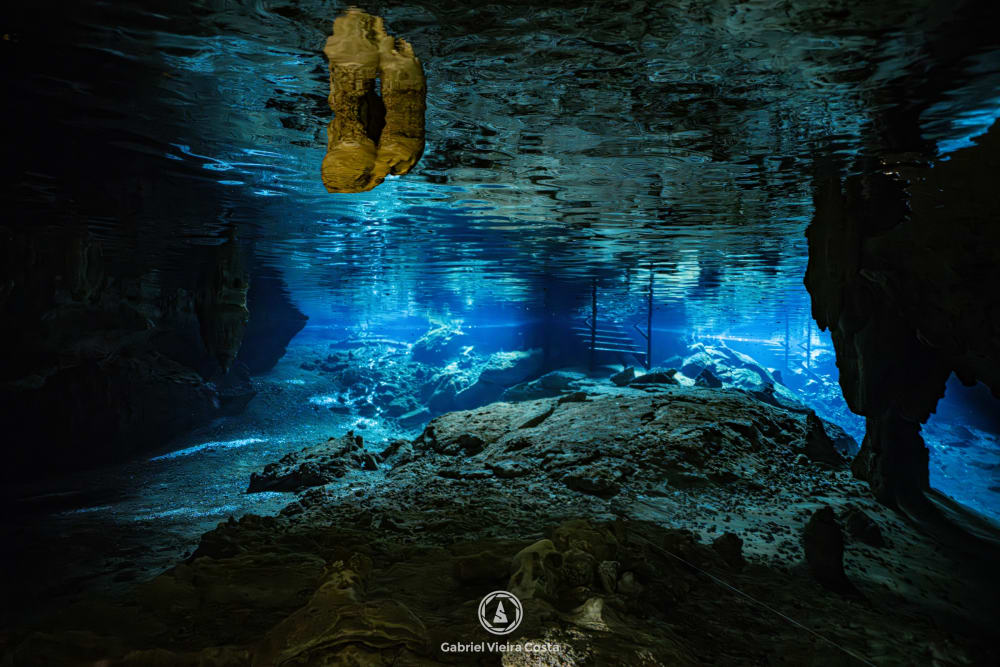
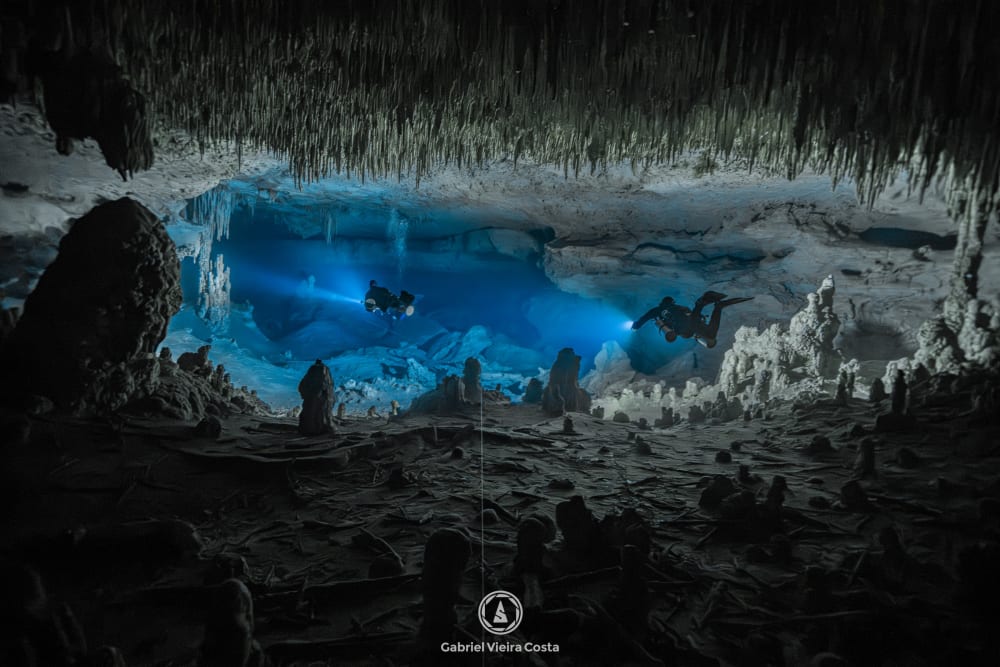
A cavern dive stays in the daylight zone: the sun still reaches in and the exit is in sight. A cave dive is what comes next, with no daylight. The distance limit for cavern varies: DAN cites 130 feet (40 meters) to the surface in Florida, and TDI cites 200 feet (61 meters).

There may be a sign at the boundary. In Florida springs, it tells divers to stop, prevent their own death, and go no farther. The NSS-CDS supports these signs because, to an untrained diver, the danger looks much smaller than it is.

A guided cenote tour stays in the daylight zone. DAN Europe's advice: a guide with cave certification and cave equipment, no more than four divers per guide, and never leaving the cavern route without cave training.

If the sunlight is gone, it is already a cave dive.

Cave diving courses: the TDI path

The equipment is redundant: more than one cylinder, extra regulators, reel and line, three lights. The idea is that a single failure should not decide the dive.

You learn to use it all in the course. Each certification has a limit, and each one opens the door to the next.

  • Cavern Diver: age 18, or 15 with parental consent, an open water certification, and 25 logged dives.
  • Intro to Cave: requires Cavern. Allows following a single guideline.
  • Full Cave: requires Intro to Cave and age 18.

Cave courses at Mergulho Técnico, in Brazil (in Portuguese) →

Where people cave dive: Mexico, Florida, and Brazil

Near Tulum lies Ox Bel Ha, with about 542 km (337 miles) mapped, the longest known underwater system in 2026. In Florida, going past daylight requires cave certification.

In Brazil, a 2006 rule from Ibama, the federal environmental agency, only allows diving in flooded caves under a licensed or authorized project, and commercial operations need an environmental license. Confirm the current rule with the operator and with Cecav, part of ICMBio.

  • Bonito (Mato Grosso do Sul), Abismo Anhumas: rappel, snorkeling, an introductory dive to 8 meters (26 feet), and dives to 18 meters (60 feet) for certified divers.
  • Jardim (Mato Grosso do Sul), Lagoa Misteriosa: a flooded cave with snorkeling, accompanied introductory dives, and routes by certification level.
  • Mariana (Minas Gerais), Mina da Passagem: a closed gold mine with flooded levels used for diving and cave training.

Fear and myths

Accidents become news and movies. A dive called off for safety never does. Fear is a good reason to stay out.

  • An experienced ocean diver will manage: myth. Cave training is a different thing.
  • Clear water is safe: myth. Silt changes that in seconds.
  • Training removes the risk: myth. The numbers above show it.
  • Caves should just be closed: the NSS-CDS stands for education and signs.

Photography only after training

I am an SDI/TDI Instructor Trainer, and I have photographed caves in Tulum and Florida and the Passagem mine in Brazil. Today I use only continuous light. A camera adds tasks, time, and distraction to a dive that already asks a lot. First the cave, without a camera. Then the camera.

How to photograph caves and cenotes →

By Gabriel Vieira Costa, underwater photographer, World Top 10 at 35AWARDS 2025 and 2026 and SDI/TDI Instructor Trainer.
Frequently asked questions

Is cave diving dangerous?

Yes. Without training, it can be fatal. With a course, the right equipment, and limits, the risk is managed, but it is still there, because the ceiling blocks a direct ascent.

What is the difference between cavern and cave diving?

Cavern diving stays in the daylight zone, with the exit in sight. Cave diving is the part with no daylight, and it requires cave training.

Do I need a certification to dive a cenote?

To scuba dive, you need a course and a certification. The guided tour stays in the daylight zone. Beyond it, only with a cave certification. If the guide suggests going past it, say no.

Can you go cave diving in Bonito, Brazil?

Abismo Anhumas offers snorkeling, an introductory dive to 8 meters, and dives to 18 meters for certified divers, always through the operator. These tours do not replace a cave course.

What are the cave diving courses?

At TDI, the sequence is Cavern Diver, Intro to Cave, and Full Cave. The first one asks for an open water certification and 25 logged dives.

Already cave trained? Take the camera further

The cave photography masterclass covers light setups, team roles, and the settings read from my own cave photos, online and at your own pace.

And for your screen

My photos as free wallpapers, for desktop and phone.

More guides

How to take photos underwater

How to take photos underwater

Why underwater photos come out blue and flat, and five practical steps to fix them with a phone, action camera, compact, or mirrorless.

Read the guide
How to choose an underwater camera and housing

How to choose an underwater camera and housing

Goal, total system cost, housing, dome or flat port, and lighting: the order of questions to pick an underwater camera without wasting money.

Read the guide
How to choose an underwater housing for a mirrorless or DSLR

How to choose an underwater housing for a mirrorless or DSLR

How to choose an underwater camera housing: exact model, aluminum or polycarbonate, dome ports, vacuum, strobe triggering, O-rings, and buying used.

Read the guide
Isotta housings: a guide from choosing to diving

Isotta housings: a guide from choosing to diving

A practical guide to Isotta housings: choosing by camera, ports and domes by lens, vacuum test, setup, care, accessories and buying in Brazil.

Read the guide
How to take underwater photos with a phone

How to take underwater photos with a phone

Housing, depth, light, filters, and how to avoid a flood: what works and where a phone hits its limits when you take photos underwater.

Read the guide
Can you take underwater photos with an iPhone or any other phone?

Can you take underwater photos with an iPhone or any other phone?

iPhone 12 to 17 are IP68, 6 meters for 30 minutes, but Apple's warranty won't cover water damage. Pools, the ocean, Galaxy, Pixel, and the safe way.

Read the guide
How to use an action camera for scuba diving

How to use an action camera for scuba diving

The GoPro HERO13 goes to 10 meters without a housing and 60 with one. See how Insta360 and DJI compare, plus red filters, video lights, and distance.

Read the guide
How to use an Insta360 for scuba diving

How to use an Insta360 for scuba diving

Insta360 X3, X4, X5, and X6 for diving: depth with and without a dive case, sealing it, 360 mode, invisible stick, settings, light, and care.

Read the guide
How to film underwater

How to film underwater

How to film underwater with a phone, GoPro, or mirrorless camera: housing and depth, stability, color, 4K and frame rate, framing, sound, and safety.

Read the guide
Underwater strobes: how to use your flash

Underwater strobes: how to use your flash

What a strobe is for, where to put your arms and strobes, how to avoid backscatter, how much power to use, and when to switch the strobes off.

Read the guide
How to edit underwater photos

How to edit underwater photos

The order of adjustments for editing underwater photos in Lightroom: white balance, light, haze, color, and cleanup, and why water turns it all blue.

Read the guide
How to photograph caves and cenotes

How to photograph caves and cenotes

How to photograph caves and cenotes: exposure in the dark, continuous light from dive lights, team and model, composition, and safety first.

Read the guide
How to photograph sharks and big animals

How to photograph sharks and big animals

Sharks, manta rays, and whale sharks: wide-angle lens, distance, natural light or strobes, shutter speed, and respect for the animal.

Read the guide
Where to take underwater photos in Brazil

Where to take underwater photos in Brazil

Laje de Santos, Angra, Ilha Grande, Ilhabela, Noronha, Recife, and Natal: what to photograph underwater at each, the best season, and what to pack.

Read the guide
Where to dive with sharks, in Brazil and worldwide

Where to dive with sharks, in Brazil and worldwide

Where to dive with sharks: Noronha, Bahamas, Cocos, Galápagos, Maldives, Red Sea, and Revillagigedo, with species, season, skill level, and safety.

Read the guide