Where to dive with sharks, in Brazil and worldwide

Guide · Sharks

Where to dive with sharks, in Brazil and worldwide

I have photographed sharks in Noronha, the Bahamas, Revillagigedo, the Galápagos, Cocos, the Maldives, and the Red Sea. This guide tells you which species you can see in each place, in which season, how much experience the diving calls for, and how to behave.

Is it dangerous to dive with sharks?

The risk is low, but it exists. ISAF, the Florida Museum's worldwide file of shark incidents, confirmed 65 unprovoked bites in 2025, with nine deaths. Almost all involved swimmers and waders (46%), surfers (32%), and snorkelers or freedivers (15%). Scuba diving is not even listed as a category of its own.

The same report counts 29 provoked bites, in which the person started the interaction. These include divers who harassed or tried to touch a shark, spearfishing, and people feeding the animal.

Much of the risk depends on the diver: don't touch, don't chase, don't feed.

Where to dive with sharks in Brazil

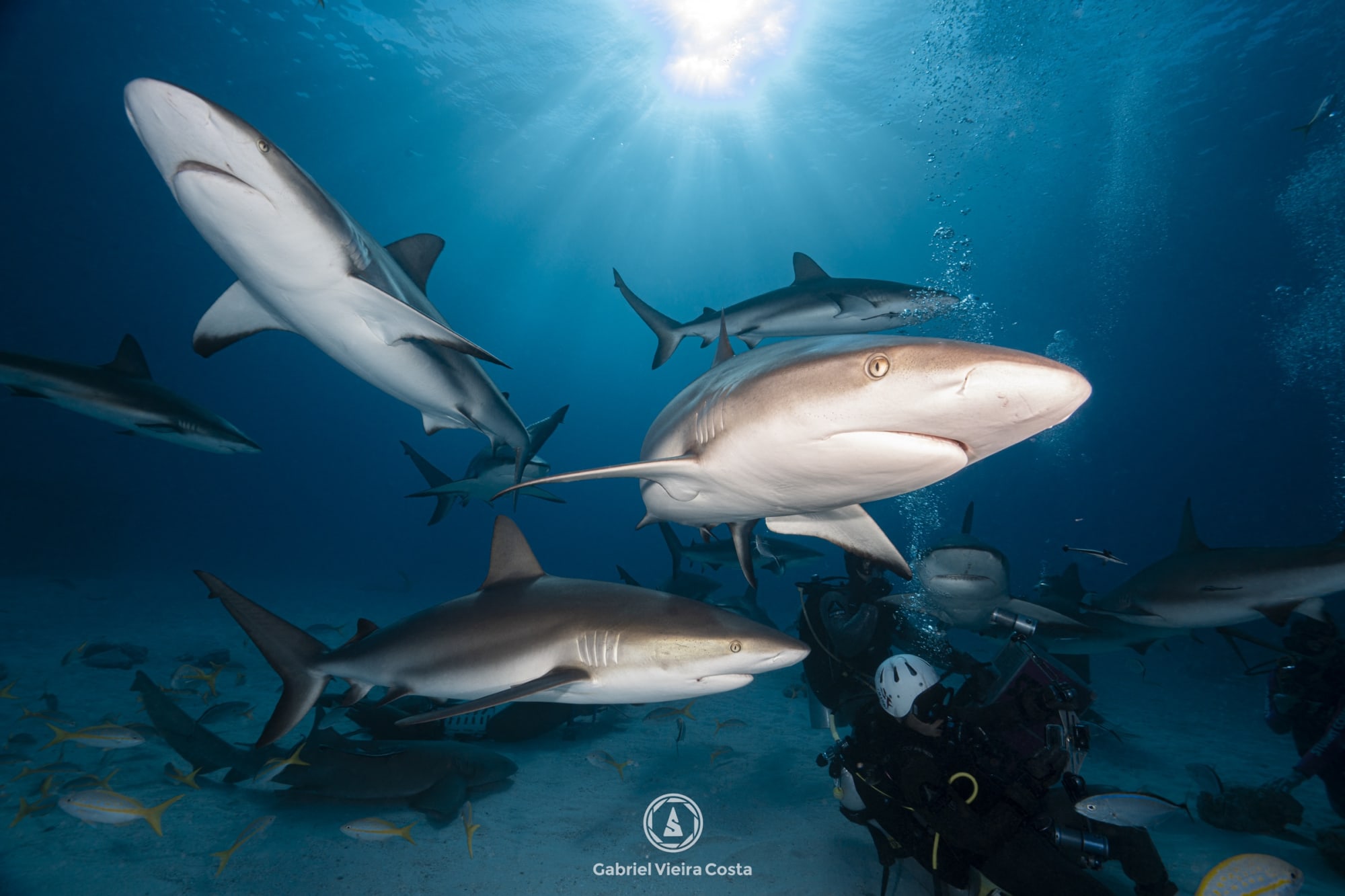
In Fernando de Noronha, three species use the archipelago to give birth and grow: the Caribbean reef shark, which is the most numerous, the nurse shark (known locally as lambaru), and the lemon shark. The best sea conditions run from August to December. In the environmental protection area, touching, chasing, and feeding are forbidden. After nurse shark bites in January 2026, ICMBio, Brazil's conservation agency, spoke of provoked incidents, linked to food used to attract the animals.

Elsewhere, encounters are less predictable and the rules change:

  • Alcatrazes (São Paulo): a study recorded sand tiger sharks in both summer and winter. It is an ICMBio wildlife refuge, and only registered companies operate there.
  • Recife (Pernambuco): nurse sharks on the wrecks of the Parque dos Naufrágios.
  • Rocas Atoll (Rio Grande do Norte): a lemon shark nursery, but it is a biological reserve, closed to tourism.

Sharks of the Brazilian coast, species by species, on the Dive For Fun blog (in Portuguese) →

Where to dive with hammerhead sharks

These are open-ocean places. Except for Bimini, the usual way to go is by liveaboard, the boat you sleep on.

  • Cocos (Costa Rica): hammerhead schools from June to October, in the rainy season. The crossing takes about 36 hours.
  • Galápagos (Ecuador): hammerheads all year, with schools at Darwin and Wolf, in the north.
  • Revillagigedo (Mexico): the season runs from November to May, with hammerheads and silky, Galápagos, and whitetip reef sharks.
  • Red Sea (Egypt): Daedalus is the place for schools. The hammerheads stay shallower in May and June, then go deeper.
  • Bimini (Bahamas): great hammerheads gather there in the northern winter.

Where to dive with whale sharks

In Brazil, a study showed whale sharks all year around Saint Peter and Saint Paul, a remote archipelago in the middle of the Atlantic. To plan a trip, these places have a known season and known rules:

  • Maldives: in the south of Ari Atoll, all year.
  • Galápagos: June to November, with colder water and stronger current.
  • Revillagigedo: no single season. Sources mention November and December, and from April on.
  • La Paz (Mexico): October to April, snorkel only, with a guide and a small group.

In the Maldives and La Paz, touching whale sharks or using flash with them is against the rules.

Bahamas, Maldives, and Red Sea: other species

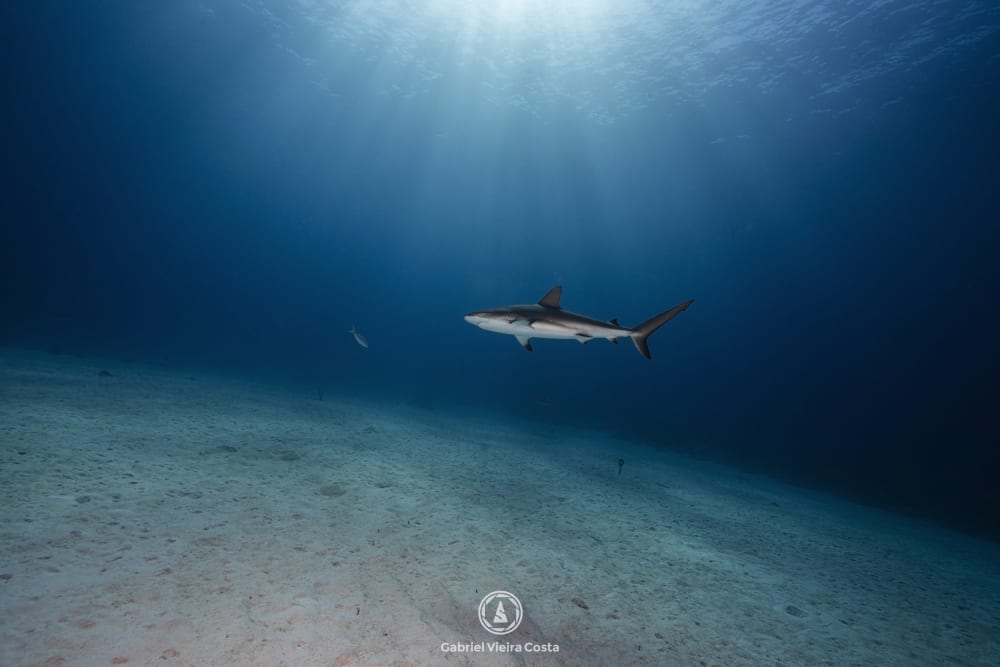
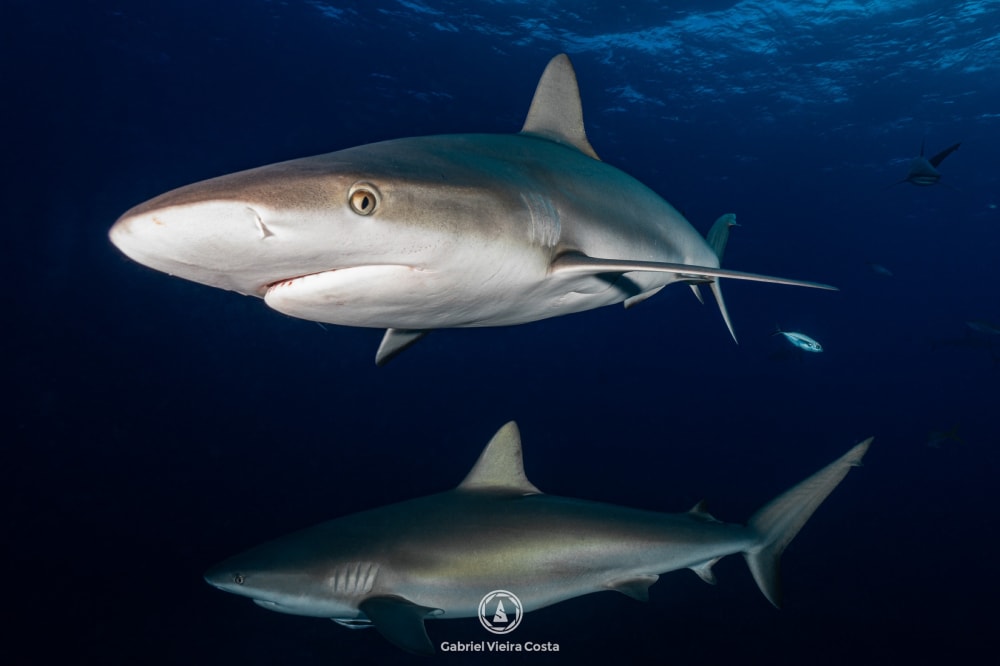
In Nassau, in the Bahamas, the shark is the Caribbean reef shark, and that is the one I photographed there. At Cat Island, oceanic whitetips pass from late March to mid-June.

In the Maldives, the current in the channels concentrates reef sharks. At Miyaru Kandu, you dive hooked to the edge while they go by. At Dhiggiri it is nurse sharks, in the shallows. Fuvahmulah, in the south, has tiger and thresher sharks all year.

In the Red Sea, oceanic whitetips are more common from September to June at the offshore islands and reefs, such as the Brothers and Elphinstone.

How much experience each place calls for

What matters is the current, blue water with no bottom in sight, the depth, and ascending away from the reef. Examples of what operators publish:

  • Nassau: a diving certification and a dive in the last three years, or a refresher.
  • Red Sea, offshore islands: from Open Water with 30 dives to Advanced with 50, depending on the boat.
  • Revillagigedo: most boats ask for Advanced and 50 dives.
  • Cocos: Advanced (or Deep) and nitrox, with 50 dives recommended.
  • Galápagos: a local agency recommends 50 dives from December to May and 100 from June to November.

How to behave, with and without bait

Stay with the group, with slow movements and hands close to your body. If a shark approaches, stay vertical, face it, and follow it with your eyes. Don't turn your back to swim away. If it becomes agitated, move off calmly. With oceanic whitetips, the advice in Egypt is to stay below 5 meters (16 feet) and spend little time on the surface. In the Galápagos and Revillagigedo, the minimum distance from wildlife is 2 meters (6.5 feet).

Baited dives exist. In Nassau, there is an operator that does one dive without bait and one with it. Revillagigedo, on the other hand, forbids attractants, and the Maldives diving regulation does not allow shark feeding. If you go on a baited dive, find out beforehand how it works. The crew handles the bait.

For the photo, choose your position, have the camera ready, and wait.

How to photograph sharks and big animals →

How to choose the trip and the operator

Choose the species first, then the season, and check that your level matches the place. Scuba diving only with training and certification.

  • Is it authorized by the park or the protected area?
  • Does it brief you on behavior and say how many divers go with each guide?
  • Does it publish its requirements and tell you whether it uses bait?
  • Does it require dive insurance with evacuation? In a remote place, have it.

Dive trips with Dive For Fun, my school →

By Gabriel Vieira Costa, underwater photographer, World Top 10 at 35AWARDS 2025 and 2026 and SDI/TDI Instructor Trainer.
Frequently asked questions

Is it dangerous to dive with sharks?

The risk is low, but not zero. In 2025, ISAF counted 65 unprovoked bites worldwide, almost all involving swimmers, surfers, and snorkelers or freedivers. Follow the guide, don't touch, don't chase, and don't feed.

Where can you dive with sharks in Brazil?

Fernando de Noronha is the main destination, with Caribbean reef, nurse, and lemon sharks. Alcatrazes, in São Paulo, has sand tiger sharks, and the wrecks off Recife have nurse sharks.

Where can you dive with whale sharks?

In the south of Ari Atoll, in the Maldives, all year. In the Galápagos, from June to November. In La Paz, Mexico, from October to April, snorkel only.

Where can you dive with hammerhead sharks?

In Cocos, from June to October. In the Galápagos, all year. In Revillagigedo, from November to May. In the Red Sea, at Daedalus, with better odds in May and June.

How many dives do you need to dive with sharks?

It depends on the place. In Noronha, an Open Water certification opens most sites. In Cocos, Revillagigedo, and the Galápagos, count on at least 50 dives and practice in current.

Meet the shark knowing how to photograph it

The Underwater Photography masterclass covers light, exposure, and wide angle, module by module, from a photographer who has dived in more than 60 countries.

And for your screen

My photos as free wallpapers, for desktop and phone.

More guides

How to take photos underwater

How to take photos underwater

Why underwater photos come out blue and flat, and five practical steps to fix them with a phone, action camera, compact, or mirrorless.

Read the guide
How to choose an underwater camera and housing

How to choose an underwater camera and housing

Goal, total system cost, housing, dome or flat port, and lighting: the order of questions to pick an underwater camera without wasting money.

Read the guide
How to choose an underwater housing for a mirrorless or DSLR

How to choose an underwater housing for a mirrorless or DSLR

How to choose an underwater camera housing: exact model, aluminum or polycarbonate, dome ports, vacuum, strobe triggering, O-rings, and buying used.

Read the guide
Isotta housings: a guide from choosing to diving

Isotta housings: a guide from choosing to diving

A practical guide to Isotta housings: choosing by camera, ports and domes by lens, vacuum test, setup, care, accessories and buying in Brazil.

Read the guide
How to take underwater photos with a phone

How to take underwater photos with a phone

Housing, depth, light, filters, and how to avoid a flood: what works and where a phone hits its limits when you take photos underwater.

Read the guide
Can you take underwater photos with an iPhone or any other phone?

Can you take underwater photos with an iPhone or any other phone?

iPhone 12 to 17 are IP68, 6 meters for 30 minutes, but Apple's warranty won't cover water damage. Pools, the ocean, Galaxy, Pixel, and the safe way.

Read the guide
How to use an action camera for scuba diving

How to use an action camera for scuba diving

The GoPro HERO13 goes to 10 meters without a housing and 60 with one. See how Insta360 and DJI compare, plus red filters, video lights, and distance.

Read the guide
How to use an Insta360 for scuba diving

How to use an Insta360 for scuba diving

Insta360 X3, X4, X5, and X6 for diving: depth with and without a dive case, sealing it, 360 mode, invisible stick, settings, light, and care.

Read the guide
How to film underwater

How to film underwater

How to film underwater with a phone, GoPro, or mirrorless camera: housing and depth, stability, color, 4K and frame rate, framing, sound, and safety.

Read the guide
Underwater strobes: how to use your flash

Underwater strobes: how to use your flash

What a strobe is for, where to put your arms and strobes, how to avoid backscatter, how much power to use, and when to switch the strobes off.

Read the guide
How to edit underwater photos

How to edit underwater photos

The order of adjustments for editing underwater photos in Lightroom: white balance, light, haze, color, and cleanup, and why water turns it all blue.

Read the guide
How to photograph caves and cenotes

How to photograph caves and cenotes

How to photograph caves and cenotes: exposure in the dark, continuous light from dive lights, team and model, composition, and safety first.

Read the guide
How to photograph sharks and big animals

How to photograph sharks and big animals

Sharks, manta rays, and whale sharks: wide-angle lens, distance, natural light or strobes, shutter speed, and respect for the animal.

Read the guide
Where to take underwater photos in Brazil

Where to take underwater photos in Brazil

Laje de Santos, Angra, Ilha Grande, Ilhabela, Noronha, Recife, and Natal: what to photograph underwater at each, the best season, and what to pack.

Read the guide
Is cave diving dangerous?

Is cave diving dangerous?

Is cave diving dangerous? Without training, it can be fatal. See the classic accident causes, cavern vs cave, the courses, and where people dive.

Read the guide